
Buying Guides · September 15, 2026 · 4 min read
Travertine Pool Coping: Bullnose, Eased Edge or Drop-Face?
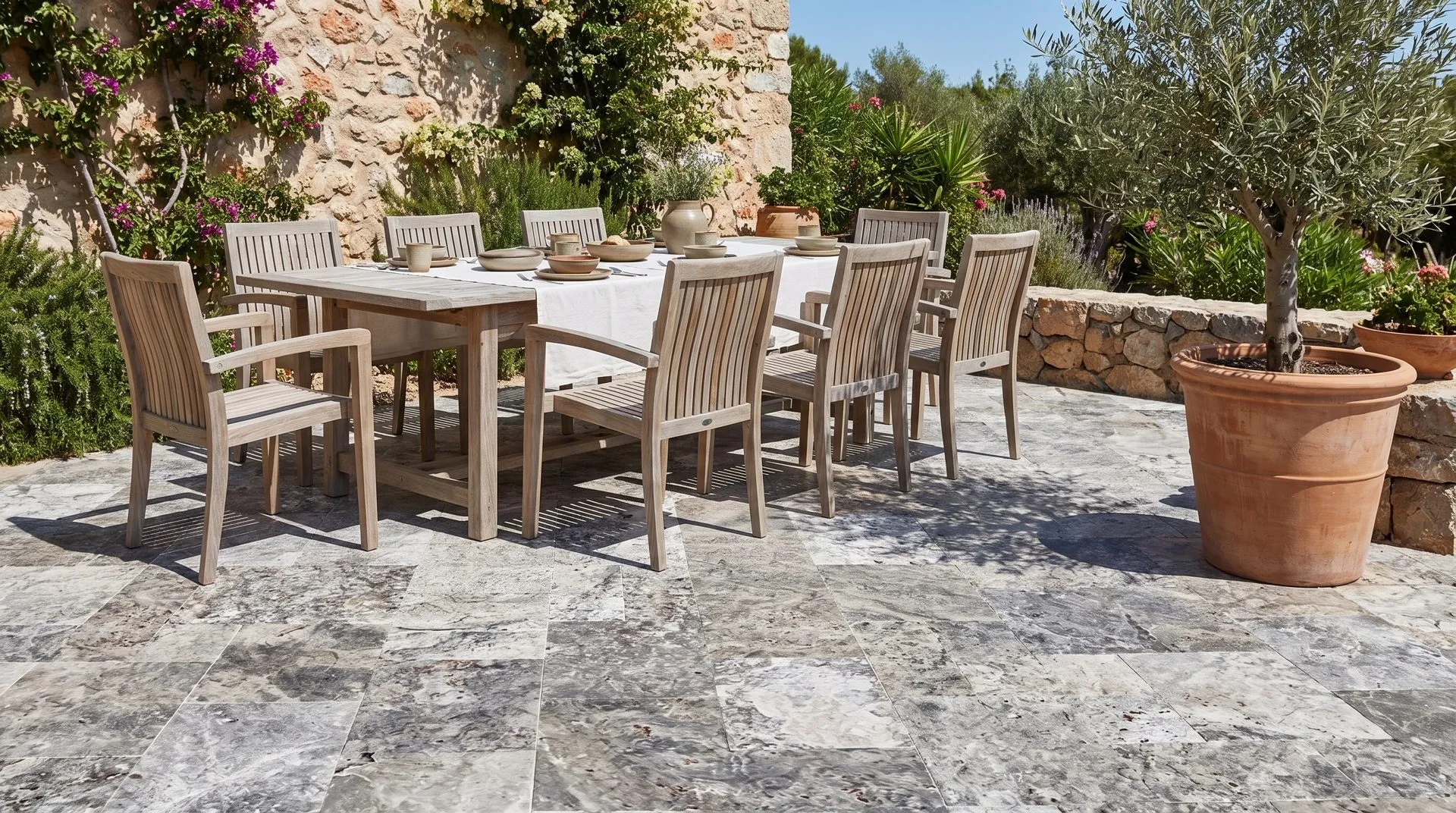
Pool coping is the piece of stone the whole project gets judged on. Swimmers touch it, photographs frame it, and it is the first thing to look wrong if the profile does not match the deck. In the US market it is sold under a handful of names — bullnose, eased edge, bevel, drop-face — and the names are the specification. Here is what each one is, what it is cut in, and how to order it so the coping and the pavers arrive as one stone.
The four profiles
Bullnose (rounded edge). The classic. The front edge is milled to a full half-round so there is no arris to catch a shin or a pool cover. It sits flush with the deck and works with any deck size. In our program it is GH-MG-001: 13″ (33 cm) wide, 24″ / 39″ / 47″ long (61 / 100 / 120 cm), in 3 cm (1¼″) or 5 cm (2″).
Eased edge (honed edge). A flat front face with the top arris softened by a few millimetres. It reads cleaner and more contemporary than bullnose and is the usual choice with 24″×24″ or larger deck pavers. Same sizes and thicknesses as bullnose.
45° bevelled edge. The front face is chamfered at 45°, single or double face. Less common on residential pools, more common on commercial decks and spa surrounds where a crisp line is wanted. GH-MG-002 in our program, same sizes.
Drop-face (drop-out). The profile most modern gunite pools are drawn with. The coping has a downturned lip that covers the bond beam and the shell edge, so the pool reads as if it were finished with a thick slab. The visible face is cut at 1.2–3 cm or 2–5 cm (½″–1¼″ or ¾″–2″); the top can be rounded (GH-MG-003) or straight (GH-MG-004). Because the lip carries the look, drop-face lets a 3 cm piece do the job of a 2″ one.
Pieces the drawing will need
A straight run of coping is the easy part. The pieces that stop a job mid-install are the special ones, so count them from the pool drawing before the order goes in:
- Radius sections for curved walls, cut as true arcs. Standard radii in our program are R150 cm (59″) and R200 cm (79″); other radii are cut to the drawing. Faceting a curve out of straight pieces is the most common mistake we see in photographs — the joints fan and the edge looks chopped.
- Inside corners (GH-MG-005, 16″×16″ or 18″×18″) and outside corners (GH-MG-006, 13″×13″) so the profile turns without a mitre cut on site.
- Step blocks — solid 6″ (15 cm) thick treads at 24″, 39″ or 47″ long — for entry steps that should look like the coping, not like a paver stood on edge.
- Drain channels, flat or curved, at 5″, 8″ or 10″ × 24″, where the deck sheds water to a slot instead of a grate.
The full list of profiles and sizes is on the pool coping page.
Which finish
Tumbled is the default for coping the way it is for pavers: the surface has enough texture to be slip-resistant wet, and the softened edges hide small chips over the years. Brushed gives a flatter, satin face for contemporary decks. Filled & honed is specified where the coping continues an interior floor out through a sliding door — and then the deck is usually filled & honed too.
Whatever the finish, seal travertine coping once a year in a chlorinated or salt-water pool. It is a calcium carbonate stone; the sealer keeps chlorides and sunscreen out of the pores and is the only maintenance the stone asks for.
Order the coping with the deck
Travertine is a natural stone and every block is slightly different. Coping ordered three months after the pavers, from a different lot, will match the deck the way two dye lots of paint match — nearly. The fix is procedural: specify the coping and the deck pavers together, from the same collection and block selection, and have them crated and shipped together. Cut-to-order profiles carry a production lead time, so we quote the coping and the pavers as one program with one delivery date into New Jersey.
For colour, every GoodzHub travertine collection is cut into the full coping program — Ivory Blend Premium and the classic blends for bright decks, Silver for grey schemes, Noce where the edge should read as a dark band. Send the pool perimeter in linear feet, the profile and the collection, and we return trade pricing and lead time within one business day.
FAQ
- What is the difference between bullnose and eased-edge pool coping?
- Bullnose is a fully rounded front edge; eased (or honed) edge is a flat face with the sharp arris softened. Both sit flush with the deck. Bullnose is the traditional, softer look and the more forgiving edge for swimmers; eased edge reads more contemporary and pairs with large-format decks.
- What is drop-face coping?
- Drop-face (drop-out) coping has a lip that turns down over the pool's bond beam, hiding the beam and the shell edge. The visible face is 2–5 cm (¾″–2″) deep. It is the standard profile on modern gunite pools where the designer wants a thick stone edge without a thick slab.
- How thick should travertine pool coping be?
- Two thicknesses are standard: 3 cm (1¼″) and 5 cm (2″). Two-inch coping is the usual specification in the US because it reads as a substantial edge, tolerates the occasional knock, and matches the 2″ bullnose that retailers list. Three centimetre coping suits pedestal decks and budget programs.
- Can travertine coping be cut for a curved pool?
- Yes. Radius pieces are cut as true arcs — our program runs R150 cm (59″) and R200 cm (79″) as standard and other radii to the drawing — so a curved wall does not have to be faceted from straight pieces.