
Buying Guides · September 21, 2026 · 8 min read
Is Travertine Expensive? Cost per Square Foot in 2026
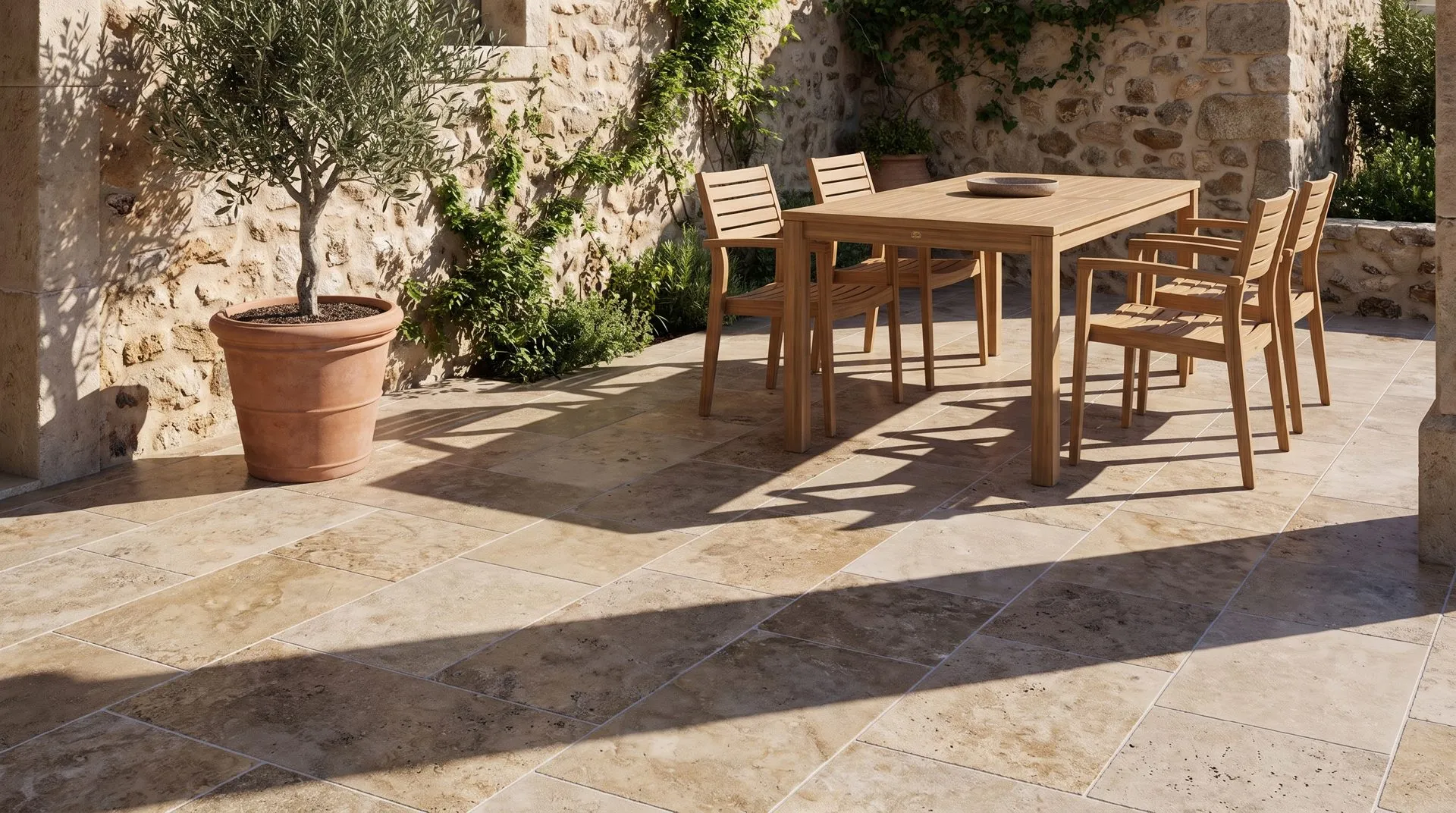
Is travertine expensive? It depends almost entirely on the grade. US cost guides updated in 2026 put travertine pavers anywhere from $5 to $30 per square foot for the stone alone, and $13 to $45 installed — a sixfold spread that has little to do with the quarry and a lot to do with what is being specified. This guide sets out the published ranges for pavers, tile and pool coping, then walks through the seven things that decide where a trade order lands inside them.
We do not publish a list price: quantity, grade and shipping basis move the per-square-foot figure too much for a single number to be honest. The figures below are national retail and installed ranges from third-party cost guides. They are the right frame for a budget; they are not GoodzHub prices.
The short answer: 2026 market ranges
Material is what a distributor or importer sells; installed adds labor, base and supplies.
| Product | Material (per sq ft) | Installed (per sq ft) | Source |
|---|---|---|---|
| Travertine pavers | $5–$30 | $13–$45 | HomeGuide, Apr 2026 |
| Travertine pavers | — | $15–$27 | Angi, May 2026 |
| Travertine pavers, small basic job | — | $20–$26 | Homewyse, May 2026 |
| Travertine tile, Premium | $10–$30 | $20–$50 | HomeGuide, Jul 2025 |
| Travertine tile, Standard | $7–$15 | $17–$35 | HomeGuide, Jul 2025 |
| Travertine tile, Commercial | $4–$7 | $14–$27 | HomeGuide, Jul 2025 |
| Travertine pool coping (per linear ft) | — | $55–$80 | HomeGuide, Jan 2026 |
Read the table with two cautions. First, the guides describe retail purchases and homeowner projects; trade pricing by the pallet or container sits below retail — HomeGuide puts the saving at 10–20% for buying by the pallet alone. Second, installed figures swing with labor and scope. HomeGuide's installed travertine coping range is $55–$80 per linear foot, while Homewyse's calculator comes in under $30 per linear foot for basic conditions, before the 13–22% contractor overhead it tells you to add.
1. Grade is the biggest single lever
Travertine is sorted at the factory by pore density, filling, colour consistency and edge condition. The same quarry sells the same stone under several grades, and the price steps between them are large. HomeGuide's 2026 bands for pavers, material only:
- Select / honed — hand-picked, tightest colour range: $18–$30 per sq ft.
- Premium — consistent colour, few voids: $12–$20 per sq ft.
- Standard — more colour movement and visible pores, structurally the same stone: $8–$12 per sq ft.
- Commercial — widest variation, used on large areas where the blend carries the look: $5–$8 per sq ft.
Our collection pages state the grade on every line, with the factory reference so samples can be matched to production. Ivory Blend Premium, Classic Light Premium and Country Classic Premium are Premium Select; Noce, Antique Silver Blend, Valencia and Autumn Blend are Premium; Country Classic Standard is Standard; Ivory Commercial and our silver travertine are Commercial, with Silver also cut in Premium Select to order.
At the guide's bands, moving from Premium to Standard is a difference of roughly $4–$8 per square foot — $4,000–$8,000 on a 1,000 sq ft deck. It is the specification decision most likely to move a quote by four figures, and on a large deck laid in a classic blend the extra colour movement of a Standard grade can be part of the look rather than a compromise.
2. Thickness and format
Price follows stone volume first. HomeGuide's 2026 bands per square foot: ½″ (1.2 cm) at $5–$10, 1″ at $7–$15, 1¼″ (3 cm) at $8–$18 and 2″ (5 cm) at $12–$25. The 1.2 cm material is interior travertine tile; the 3 cm material is the paver that US pool decks and patios are built from.
Within one thickness, large formats generally cost more per square foot than small ones, because fewer sound large pieces come out of each block. A French pattern set is priced by the module — 16 sq ft for the standard four-piece set, 36 sq ft for the grand set — so the square footage of the job, not the piece count, is what goes on the quote.
Coping is priced per linear foot rather than per square foot, and by profile. Our standard pieces are 13″ (33 cm) wide by 24″, 39″ or 47″ long, at 1¼″ or 2″ thick; a straight bullnose is simpler to machine than a drop-face piece, and radius pieces for curved walls are cut as arcs to the pool drawing. Our pool coping guide explains when each profile earns its cost.
3. Finish
Tumbled is the base finish for exterior work and the least expensive: $7–$15 per sq ft in HomeGuide's 2026 paver guide. Brushed and chiseled-edge finishes run $8–$16, honed $10–$20 and polished $12–$25; its tile guide puts filled interior tile at $10–$24. For a pool deck, tumbled is both the cheapest finish and the usual specification: the texture gives grip when wet and hides wear. An ivory travertine deck in a tumbled finish is the classic version of that specification.
4. Pallet from stock or container from the quarry
This is where a trade quote diverges most from retail. HomeGuide puts a pallet of pavers at about 160–200 sq ft and the saving for buying by the pallet at 10–20% against per-piece retail. Pallet quantities from our New Jersey stock carry no production lead time and no ocean freight to allocate.
A container program prices lower again, for arithmetic reasons. A 20-foot container loaded to US road limits carries about 19,000–20,000 kg (42,000–44,000 lb) of cargo. Three-centimetre travertine weighs roughly 15 lb per sq ft, so a full load is in the region of 2,500–2,800 sq ft of pavers — or a mixed load of pavers, coping and pattern sets for one project. Ocean freight, customs entry and drayage are paid once and spread across that whole quantity, and a full production run is priced below broken-pallet stock. The trade-off is lead time — production plus transit from Turkey to the Port of New York and New Jersey — and the need to specify the whole order up front, including a waste allowance for cuts and breakage. Our container guide covers lead times and the landed-cost lines in detail.
5. Freight and delivery
Our quotes are FOB New Jersey: the price is for the material at our New Jersey stock, and delivery is quoted separately. Delivered cost depends on distance and on whether the drop is a full truckload or LTL by the pallet — a single pallet to a residential jobsite with liftgate service costs more per square foot to move than ten pallets to a supply yard. Ask for FOB and delivered figures side by side, so a comparison with a local yard is like-for-like.
6. Duties and the 2026 tariff
Worked travertine enters the US under HTS heading 6802 and pays the ordinary duty for cut building stone. Since July 24, 2026 an additional 12.5% Section 301 duty applies to most goods of Turkish origin, on top of that ordinary duty. Exemptions are listed by tariff code, so the rate on a specific line is confirmed at entry by the customs broker.
For stock already in New Jersey, whatever duty applied has been paid and is inside the landed price. On a container order, duty is calculated at the rate in force on the date of entry, so a quote issued today and a container landing in three months can differ if the rate changes — one reason container quotes carry a 30-day validity. HomeGuide's 2026 guide still puts Italian travertine at a 20–50% premium.
7. Installation: the half of the number the stone does not control
Installed cost adds labor, base and supplies. HomeGuide puts paver labor at $8–$15 per sq ft and Angi at $5–$10 per sq ft (or $50–$100 per hour); a French pattern layout adds $1–$3 per sq ft in labor. Base preparation in HomeGuide's breakdown is excavation at $1–$3, gravel base at $1.50–$3 and sand bedding at $0.50–$1.50 per sq ft; Angi adds $300–$2,000 or more for site work such as debris removal and disposal. Sealing runs $1–$3 per sq ft.
On those numbers, labor and base together ($11–$22 per sq ft) cost more than Standard or Commercial grade stone ($5–$12 per sq ft). None of it appears on a material quote, so compare material-to-material and labor-to-labor when weighing bids.
What a trade quote should state
Whoever you buy from, a per-square-foot number only means something when the quote states:
- Collection, grade and factory reference, so samples match production
- Thickness, format and finish, with quantities in sq ft and linear ft
- Number of pallets or containers, and the waste allowance assumed
- Price basis: FOB or delivered, and to where
- How duties and tariffs are handled on imported orders
- Currency and how long the price is valid
GoodzHub quotes are in US dollars, FOB New Jersey and valid for 30 days, and we answer within one business day. Pricing steps down with pallet count and again for full-container programs.
Start from the product page that matches the job — travertine pavers, pool coping, French pattern sets or travertine tile — pick the collection, and request trade pricing with the square footage and the delivery ZIP. If you are choosing between two grades or two colours, order samples first; the price difference is only worth it when you have both pieces in hand.
Sources
Market ranges are national retail and installed figures and are not GoodzHub prices.
- HomeGuide, How much do travertine pavers cost? — updated April 16, 2026
- HomeGuide, How much does travertine tile cost? — updated July 7, 2025
- HomeGuide, How much does pool coping cost? — updated January 6, 2026
- Angi, How much do travertine pavers cost? — updated May 2, 2026
- Homewyse, cost to install travertine pavers and travertine coping — May 2026
- Federal Register, Notice of actions in the Section 301 investigations of 60 economies — July 28, 2026
FAQ
- Is travertine expensive?
- It depends on the grade more than on the stone. US cost guides updated in 2026 put travertine pavers at about $5–$30 per sq ft for material and $13–$45 per sq ft installed: Commercial grade sits at the bottom of that range, hand-selected Premium grades at the top. Trade pricing by the pallet or container sits below those retail figures.
- How much do travertine pavers cost per square foot in 2026?
- HomeGuide (April 2026) gives $5–$30 per sq ft for material, with 1¼″ (3 cm) pavers at $8–$18 and tumbled finishes at $7–$15, and $13–$45 per sq ft installed. Angi (May 2026) puts installed pavers at $15–$27 per sq ft, and Homewyse's May 2026 calculator at about $20–$26 for a small basic job before contractor overhead.
- Is Turkish travertine cheaper than Italian travertine?
- Generally yes. HomeGuide's 2026 paver guide puts Italian travertine at a 20–50% premium. The grade, thickness and finish still move the number more than the country of origin does, so compare like-for-like grades.
- Why does the price per square foot drop on a container order?
- A 20-foot container loaded to US road limits carries about 42,000–44,000 lb of cargo, which is roughly 2,500–2,800 sq ft of 3 cm travertine pavers. Ocean freight, customs entry and drayage are paid once and spread over that whole quantity, and a full production run is priced below broken-pallet stock. Pallets from New Jersey stock cost more per square foot but need no production lead time.
- What does the 2026 tariff on Turkish goods do to travertine prices?
- Since July 24, 2026 the US applies an additional 12.5% Section 301 duty to most goods of Turkish origin, on top of the ordinary tariff-schedule duty. Exemptions are listed by tariff code, so the rate on a specific product line is confirmed at entry. For material already in New Jersey stock, whatever duty applied has been paid and is inside the landed price; on a container order, duty is calculated at the rate in force on the date of entry.
- What should a per-square-foot trade quote state?
- The collection and grade, thickness, format and finish, the quantity in square feet or linear feet, the number of pallets or containers, the price basis (FOB or delivered), how duties are handled, the currency and how long the price is valid. GoodzHub quotes are in US dollars, FOB New Jersey and valid for 30 days. Installation, base preparation and sealing are separate contractor costs.