Logistics & Trade · June 1, 2026 · 5 min read
Why US Tile Buyers Are Turning to Turkey
Updated July 2026
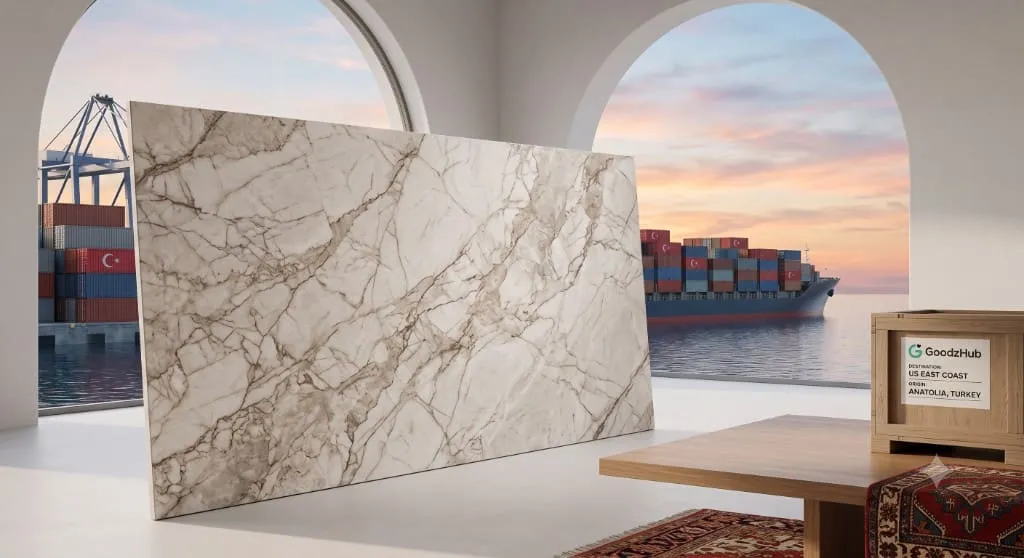
The short answer: US tile buyers are turning to Turkey because the two low-cost giants became unreliable — Chinese tile priced itself out under combined duties that exceeded 100%, and Indian imports now carry their own trade risk — while Turkish mills offer something neither did: European-grade rectified production at a mid-market landed cost, five weeks from the US East Coast. For distributors and builders re-sourcing in 2026, Turkey is less a discovery than a correction.
Here is how the market got here, what Turkish production actually delivers, and what to check before your first container ships.
A decade of re-sourcing, compressed
Until 2018, China supplied roughly a third of the imported tile Americans walked on. Then anti-dumping and countervailing duties arrived, stacking to well over 100% on most glazed porcelain. Chinese share collapsed to almost nothing within two years — not gradually, but the way a market exits when the math stops working.
India absorbed most of that volume. Morbi, its ceramic hub, scaled at a speed no other region could match, and for a while the substitution looked complete. But volume attracts scrutiny. European regulators confirmed dumping findings against Indian tile, US manufacturers filed their own petitions, and buyers who had just rebuilt their supply chains once began asking whether they were about to do it again.
That is the context in which Turkey stopped being a footnote. Trade press covering the shift has named the same shortlist for years — Spain, Italy, Brazil, Mexico, Turkey — and Turkey occupies a position on that list none of the others quite hold: newer production capacity than most of Europe, design output aimed at European taste, and pricing that sits between Indian volume and Italian prestige.
What Turkish mills actually do well
Turkey's ceramic industry is concentrated in western Anatolia, and its growth spurt came late enough that the equipment is modern by default. That timing shows up in three places a buyer can verify on a spec sheet.
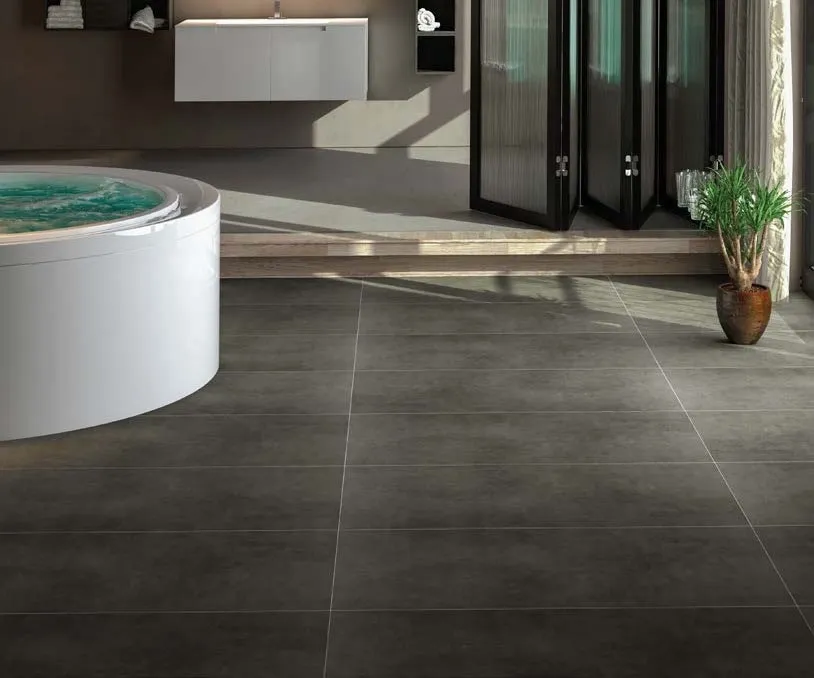
Rectified large formats as standard, not premium. The 60×120 cm (24″×48″) slab that anchors current US demand is a core format in Turkish production, not a special order. Mechanical edge calibration — what a spec sheet means by rectified — allows the tight 1/16″–1/8″ grout joints that large-format installations depend on. Collections such as Serenity run the full ladder from 60×120 down to 30×60 cm (12″×24″) with matched calibration across sizes.
European design language. Turkish mills sell most of their output westward, into markets that reject last season's surfaces. The practical effect for a US buyer is that the catalogs read current: warm greige cements like Cementino, bookmatch-friendly statement stones like Paradise, soft-veined marble looks that photograph the way designers expect. This is not a market you source from despite the design; it is increasingly why you source from it.
Porcelain that meets the number that matters. Quality porcelain is defined by water absorption at or below 0.5%, and reputable Turkish production meets it. Absorption is the property everything else hangs on — frost resistance, stain behavior, exterior use — and it is testable, which matters more than any adjective in a brochure.
The cost and duty position
Updated July 2026. Landed-cost comparisons move with freight rates and trade policy, so treat any static number with suspicion — including ours. The structural picture, though, has held for several years:
- China remains effectively closed for porcelain at duty levels that have exceeded 100% combined since 2019–2020.
- India ships at attractive EXW prices but carries the widest duty uncertainty, with active petitions and prior dumping findings in other markets.
- Spain and Italy deliver superb product at a price band that mostly serves the premium tier.
- Turkey lands on the US East Coast at a mid-band cost with, to date, none of the targeted trade actions that reshaped Chinese and Indian supply.
No sourcing decision should assume tariffs are static. What a buyer can control is exposure: shorter, direct supply chains reprice faster than long ones with inventory layered through brokers.
Verify before it ships
Distance makes inspection discipline non-negotiable. Whatever the mill, insist on four things before a container is sealed:
- First-article approval. Physical samples from the actual production run — not the showroom board — approved against an agreed reference for shade and calibration.
- Shade and caliber lot documentation. Tile varies by firing lot. Boxes must carry tone and caliber codes, and a single order should ship from a single lot wherever possible.
- Absorption and slip data in writing. Ask for test results, not claims: absorption per ISO 10545-3, slip resistance as DCOF for US commercial work (the wet benchmark is 0.42) or R-ratings for exterior surfaces.
- Photographed loading. Pallet corners, strapping, container walls. If a damage claim ever happens, the photos taken at the mill are worth more than any clause in the contract.
A buyer working through a US-based import partner should expect that partner to do all four as a matter of course. That, more than price, is what the middle layer is for.
How GoodzHub structures Turkish supply
GoodzHub was built on the thesis this article describes. We hold direct relationships with Anatolian producers, inspect at the source before loading, and run programs through the Port of New York/New Jersey — our base in Lyndhurst, NJ sits twelve miles from the Newark–Elizabeth marine terminal. Distributors buy by the container, with series continuity across reorders; builders and design firms buy by the pallet from the same collections. The catalog currently spans 73 series and more than 470 surfaces, from 60×120 cm (24″×48″) polished slabs to 2 cm (3/4″) exterior pavers.
If you are weighing a first container, start with our first-timer's guide to container buying, then request a quote with your target formats and volumes. We reply within one business day.
FAQ
- Are Turkish tiles good quality?
- The credible mills produce rectified porcelain at or below 0.5% water absorption on modern equipment, comparable to mid-tier and upper-mid European output. As with any origin, quality is mill-specific — judge by test documentation and production samples, not by country label alone.
- How long does shipping from Turkey to the US take?
- Ocean transit from Turkish ports to the US East Coast typically runs 25–35 days. A realistic order-to-door timeline for direct-mill production is six to eight weeks; stocked programs ship domestically in days.
- Is there a minimum order for Turkish tile?
- Mills sell by the full container, which holds roughly 19,000–20,000 kg (42,000–44,000 lb) of tile depending on format. Import partners like GoodzHub break that down to pallet quantities for project buyers.
Featured collections